
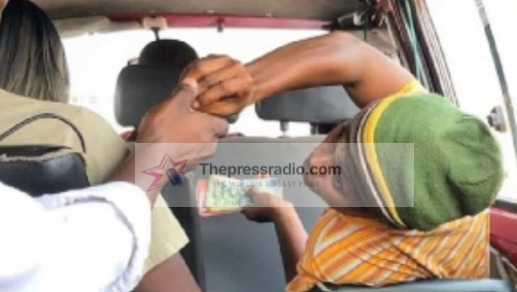
Some public transport passengers in Ghana are reportedly paying slightly more than the approved 8% fare increase because of difficulties obtaining coins needed to give exact change.
The Ghana Road Transport Coordinating Council (GRTCC) has acknowledged that the shortage of coins in circulation is making it difficult for some transport operators to implement certain fares to the exact amount contained in the revised schedule.
GRTCC General Secretary Emmanuel Ohene Yeboah explained that where the approved fare requires coins that are not readily available, operators sometimes round the amount to a convenient figure.
The development follows the implementation of an 8% increase in approved public transport fares across Ghana from September 26, 2026.
The adjustment covers shared taxis, intra-city trotros and inter-city transport services. The new rates were agreed following consultations between transport operators and the Ministry of Transport.
According to the GPRTU and GRTCC, the adjustment was based on changes in petroleum prices, spare parts, vehicle maintenance and other operating costs. Government intervention on diesel prices also helped to moderate the size of the increase, according to the transport unions.
Under the approved schedule, fares do not always increase by a whole number. For example, a trotro fare of GH¢5 rises to GH¢5.50, while GH¢10 becomes GH¢11. A GH¢15 fare increases to GH¢16.20, while GH¢20 becomes GH¢21.60.
For shared taxis, a journey of up to four kilometres rises from GH¢2.60 to GH¢2.90, while a journey of up to 20 kilometres increases from GH¢8.50 to GH¢9.20.
The challenge arises when passengers pay with notes and the operator needs to return a small amount of change. Where the required coins are unavailable, the fare may be rounded.
For instance, passengers on a route where the previous fare was GH¢50 have reportedly been charged GH¢55 instead of the GH¢54 that represents the exact 8% increase.
The GRTCC says it is aware of complaints from commuters and has deployed officers to transport terminals to monitor compliance with the approved fares.
The council has also provided operators with a template showing the old and revised fares to guide implementation and help reduce disputes between drivers and passengers.
The transport unions have directed commercial vehicle operators to display the approved fare schedules at loading terminals and stations.
They have also warned that operators who deliberately charge above the approved fares could face sanctions.
The revised fares range from GH¢5.50 to GH¢36.80 for the listed intra-city trotro categories. Shared taxi fares range from GH¢1.90 to GH¢20.20 depending on distance, while the listed inter-city fares range from GH¢27 to GH¢324.
The unions have urged both operators and passengers to rely on the official fare schedule when determining transport charges.
While the shortage of coins has been cited as a practical reason for some fares being rounded, the GRTCC’s monitoring exercise is expected to help distinguish between rounding caused by the difficulty of providing exact change and cases where operators intentionally charge more than the approved rate.
Passengers who believe they are being charged above the authorised fare have therefore been encouraged to raise the matter with the relevant transport authorities or union representatives at terminals.
Source: Thepressradio.com