
Aliko Dangote is widely known for building one of Africa’s largest business empires, with interests spanning cement, fertiliser, food production and petroleum. However, his journey to establishing the approximately $20 billion Dangote Refinery was also marked by several business setbacks and exits.
Over the years, Dangote ventured into industries that included textiles, flour production, telecommunications, food processing, aviation and banking. Some of these businesses were eventually closed, sold or abandoned after facing financial, operational or market challenges.
1. Textile businesses
Dangote’s textile investments became one of the most difficult chapters of his business career.
His group invested in textile manufacturing and acquired interests in existing textile companies. However, the businesses struggled amid competition from imported products, high operating costs and difficulties with electricity supply.
Dangote has reportedly described textiles as one of his biggest business mistakes. The closures affected thousands of workers and created significant pension and gratuity obligations for the companies involved.
2. Dangote Flour Mills
Dangote also experienced difficulties in the flour business.
Dangote Flour Mills was established in 1999 and later listed on the Nigerian Stock Exchange. In 2012, Dangote sold a majority stake in the company to South Africa’s Tiger Brands.
After Tiger Brands later exited the Nigerian market, Dangote bought the company back before eventually leaving the flour business again.
In 2019, Olam acquired Dangote Flour Mills in a deal reportedly valued at ₦120 billion, with the business subsequently integrated into Crown Flour Mills.
3. Telecommunications
Dangote also attempted to enter Nigeria’s telecommunications sector.
The group reportedly obtained a telecommunications licence and planned to compete in an industry that was expanding rapidly at the time.
However, the proposed telecom operation faced challenges, including regulatory delays, internal disagreements and the enormous investment required to build a nationwide telecommunications network.
The project was eventually abandoned before it could develop into a major telecommunications operator.
4. Tomato processing
Another major venture was Dangote’s tomato-processing business in Kano.
The factory was launched in 2016 with the capacity to process large quantities of fresh tomatoes and was intended to help reduce Nigeria’s dependence on imported tomato products while providing a market for local farmers.
However, the facility encountered difficulties securing adequate supplies of tomatoes. Rising operating costs and insufficient raw materials affected production, and the factory experienced repeated periods of closure.
Dangote later said farmers were supplying only a fraction of the plant’s capacity, limiting the profitability of the investment.
5. Aviation
Dangote also had a short-lived venture in aviation.
In 2002, he partnered with other investors to establish Executive Jets Services, which began operations in the VIP charter market.
The company started with a nine-seat aircraft and had ambitions to expand its operations. However, operational difficulties eventually brought the venture to an end.
6. Liberty Merchant Bank
Banking was another sector in which Dangote eventually exited.
His group had interests in Liberty Merchant Bank, but the institution was eventually sold. Dangote reportedly said the proceeds from the sale were used to meet pension and gratuity obligations associated with the closure of some of his textile businesses.
The experience demonstrated the financial consequences that can follow when large industrial ventures are wound down.
From setbacks to the refinery
Despite these setbacks, Dangote continued expanding into large-scale industrial projects.
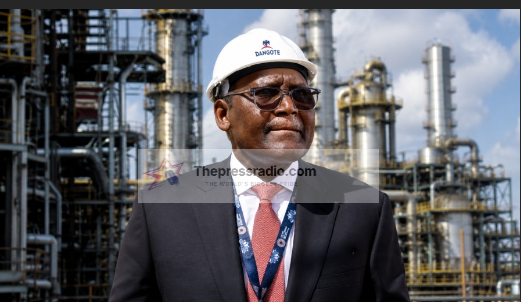
The Dangote Refinery in Lagos was developed at an estimated cost of about $20 billion. The integrated refining and petrochemical complex was designed with a nameplate capacity of 650,000 barrels of crude oil per day and occupies a site of about 2,500 hectares.
The refinery has since become the centrepiece of Dangote’s industrial expansion and one of the largest private-sector infrastructure projects in Africa.
The history of the businesses that came before it illustrates that Dangote’s business career has included both major successes and significant setbacks. Rather than a straight path of uninterrupted growth, the journey involved ventures that were closed, sold or abandoned before the businessman eventually focused on larger industrial projects.
Source: Thepressradio.com