

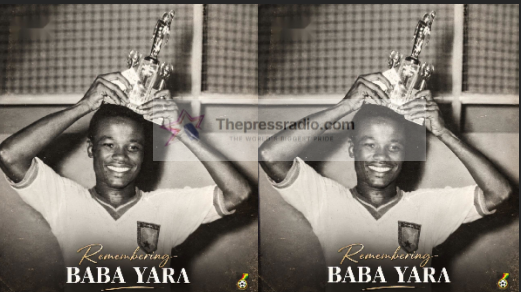
Ghanaian football legend Baba Yara remains one of the most celebrated figures in the country’s sporting history, despite having his promising career cut short by a tragic road accident at the age of 26.
Widely known as the “King of Wingers,” Baba Yara was admired for his pace, dribbling ability and attacking instincts. His performances for Asante Kotoko and the Black Stars established him as one of Ghana’s outstanding football talents during the late 1950s and early 1960s.
Born Osman Seidu Maada on October 12, 1936, in Kintampo Zongo, Baba Yara reportedly worked as a horse jockey at the Accra Turf Club before making his mark in football. His sporting ability eventually earned him an opportunity to play for Asante Kotoko, which he joined in 1955.
At Kotoko, he quickly attracted attention for his attacking qualities and ability to trouble opposing defenders. His performances helped strengthen his reputation as an exciting winger and earned him recognition beyond the club level.
Baba Yara also became an important member of Ghana’s national team, the Black Stars, at a time when the country was building its reputation in African football. His contribution to the national side made him a favourite among supporters, while his performances earned him the distinction of being named Ghana’s Footballer of the Year in 1959 and 1960.
However, his career took a devastating turn on March 24, 1963, when the team bus carrying the Real Republicans was involved in a road accident near Kpeve in the Volta Region. The team was reportedly returning from a match against Volta Heroes in Kpando when the accident occurred.
Baba Yara sustained a serious spinal injury that left him paralysed and ended his professional playing career. At just 26, the footballer was forced to abandon the sport at a time when he was still regarded as one of the country’s most gifted players.
Following the accident, he was taken to England for medical treatment at Stoke Mandeville Hospital. Despite the treatment, he did not recover sufficiently to return to the football pitch and later returned to Ghana in a wheelchair.
The injury brought an abrupt end to a career that had captivated football fans and raised expectations about what he could achieve for both club and country. His story became one of the most poignant chapters in Ghanaian football history, highlighting how an unexpected tragedy can change the course of an athlete’s life.
Baba Yara died on May 5, 1969, at the age of 32, six years after the accident that ended his playing career. Although his time on the pitch was relatively short, his contribution to Ghanaian football continued to be remembered long after his death.
His legacy is reflected in the naming of the Baba Yara Sports Stadium in Kumasi, one of Ghana’s most prominent football venues. The stadium serves as a lasting tribute to a player whose talent and achievements left a significant mark on the country’s sporting history.
Today, Baba Yara continues to be remembered as a symbol of Ghana’s football heritage. His rise from humble beginnings to national prominence, followed by the tragic end of his playing career, remains an important part of the story of Ghanaian football.
Source: Thepressradio.com