
World Bank Report Ranks Ghana’s Free SHS Among Most Impactful Social Policies Since Independence

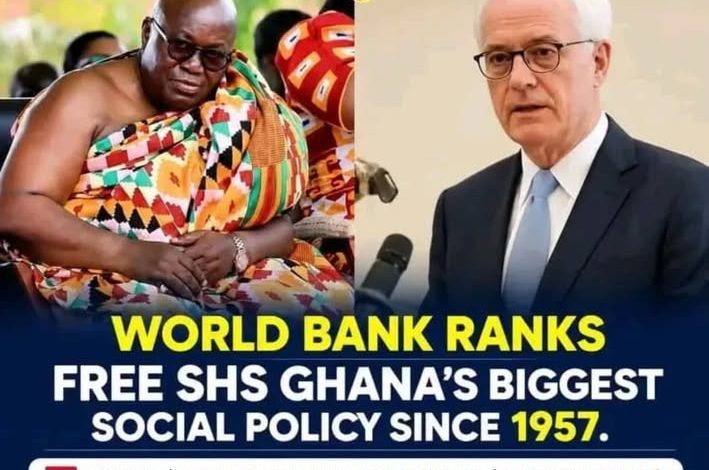
Ghana’s Free Senior High School (Free SHS) programme has been described in recent reports as the country’s most impactful public policy intervention since independence in 1957, according to claims based on a World Bank assessment cited by broadcaster and political commentator Paul Adom-Otchere.
The reported assessment has renewed debate over the significance of the Free SHS programme, which was introduced in 2017 under former President Nana Addo Dankwa Akufo-Addo.
According to reports on the World Bank assessment, the policy was evaluated based on factors including its expansion of access to secondary education, growth in enrolment and its broader contribution to human capital development. The claim has been welcomed by supporters of the programme, particularly those who have long argued that Free SHS represents one of the most transformative policies in Ghana’s Fourth Republic.
Paul Adom-Otchere argued that the reported assessment provides international backing for earlier claims made by Dr Matthew Opoku Prempeh, popularly known as NAPO, about the impact of the policy during his time as Education Minister.
The debate dates back to 2024, when NAPO, then the running mate of the New Patriotic Party, argued that no president since independence had implemented a policy with greater impact than President Akufo-Addo’s Free SHS programme. The statement generated considerable political debate, particularly because it involved comparisons with major policies introduced by previous governments.
The latest discussion has shifted attention towards measurable outcomes rather than political claims.
Free SHS was launched in 2017 with the objective of removing financial barriers that prevented many Ghanaian students from progressing to senior high school. The programme covers tuition and a range of other approved costs for eligible students in public second-cycle institutions.
The World Bank itself has acknowledged the significant expansion in Ghana’s secondary education system since the introduction of Free SHS and TVET in 2017. In a June 2026 announcement on a US$300 million education financing programme, the Bank said enrolment had risen sharply since the introduction of free secondary education, while noting that the rapid growth had also placed pressure on infrastructure, staffing and instructional quality.
The Bank said its new Ghana Secondary Education Transformation for Access, Relevance, and Results for Jobs project would help expand access to quality secondary education while improving learning and strengthening technical and vocational education.
Supporters of Free SHS point to the large increase in access as evidence of the programme’s transformative effect. Critics, however, have raised concerns about financing, overcrowding, infrastructure shortages, teacher capacity and the quality of education delivered under the expanded system.
These challenges have become an important part of the national conversation about how the programme can be sustained and improved.
Despite the debate, Free SHS has undoubtedly become one of the defining education policies of Ghana’s recent history. Its introduction changed the cost structure of secondary education for families and significantly increased the number of young people able to access senior high school.
The reported World Bank assessment is therefore likely to further fuel discussions about the programme’s long-term impact and its place among Ghana’s major social interventions since independence.
Whether Free SHS should ultimately be regarded as Ghana’s single most impactful social policy since 1957 remains a matter of interpretation, particularly given the country’s long history of major interventions in education, healthcare and social protection.
What is clear, however, is that Free SHS has fundamentally changed Ghana’s secondary education landscape and remains one of the most consequential policies introduced in the country in recent decades.
Source: Thepressradio.com