

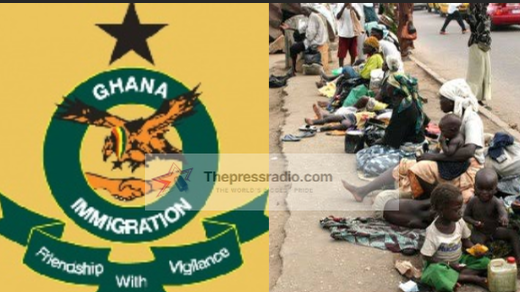
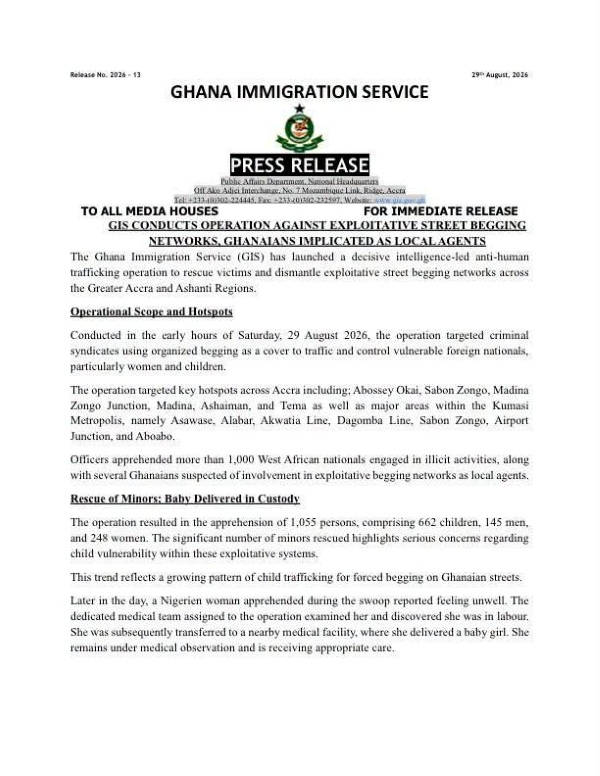
The Ghana Immigration Service (GIS) has apprehended 1,055 people in an intelligence-led operation targeting organised human trafficking and exploitative migrant street-begging networks in the Greater Accra and Ashanti regions.
The operation, which forms part of a wider campaign against organised street begging and human trafficking, focused on individuals believed to be vulnerable victims as well as suspected facilitators operating behind the networks.
According to the GIS, the 1,055 people apprehended comprised 662 children, 248 women and 145 men. The large number of children involved has raised concerns about the exploitation of minors through organised street begging.
The operation covered several known hotspots in the Greater Accra Region, including Abossey Okai, Sabon Zongo, Madina Zongo Junction, Madina, Ashaiman and Tema.
In the Ashanti Region, immigration officers also conducted operations in Asawase, Alabar, Akwatia Line, Dagomba Line, Sabon Zongo, Airport Junction and Aboabo in Kumasi.
The GIS said several Ghanaian nationals were also apprehended over suspected involvement as local agents facilitating the exploitative networks.
The Service explained that the operation was not simply aimed at removing migrants from the streets but was designed to identify and disrupt networks allegedly involved in trafficking and exploiting vulnerable foreign nationals, particularly women and children.
The scale of the operation has drawn attention to the growing concerns surrounding organised street begging in major Ghanaian cities. Authorities have increasingly focused on whether some individuals seen begging on the streets are being controlled or exploited by organised groups.
The latest exercise is also part of a broader series of interventions by the GIS. In an earlier operation in the Ashanti Region, the Service rounded up 606 individuals, including 381 children, 72 women and 153 men, many of whom were believed to be victims of human trafficking and forced begging.
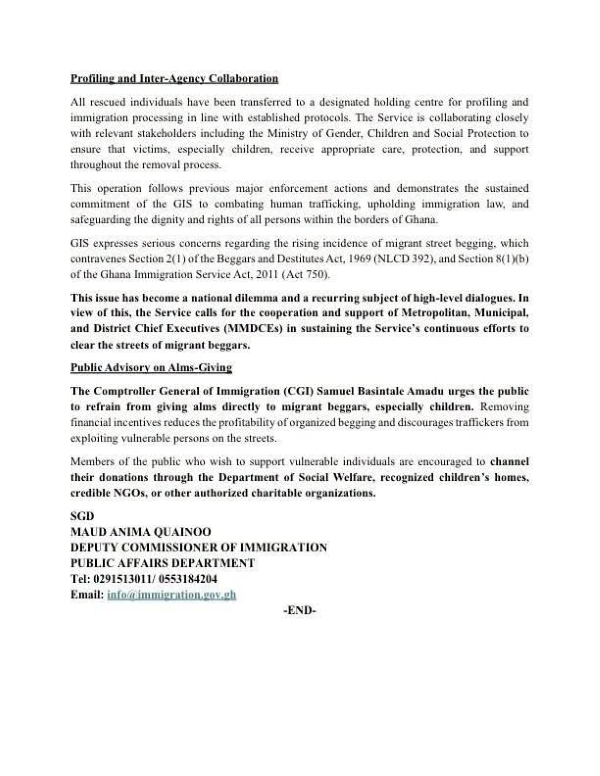
The GIS has stressed that its enforcement activities are targeted at criminal exploitation and immigration irregularities rather than legitimate movement of citizens within the Economic Community of West African States (ECOWAS).
The Service has also previously worked with diplomatic missions and other authorities to ensure that vulnerable migrants, particularly children, receive appropriate protection and assistance.
The latest arrests are expected to lead to further profiling and investigations to determine the circumstances surrounding the individuals’ presence on the streets and identify those who may be behind the alleged networks.
The GIS has urged members of the public to report suspicious activities involving foreign nationals, particularly where there are indications of trafficking, exploitation or organised begging.
The operation highlights the difficult balance between enforcing Ghana’s immigration laws and protecting vulnerable people who may themselves be victims of exploitation.
As investigations continue, authorities are expected to determine which individuals require protection and rehabilitation and whether others should face legal or immigration-related action.
Source: Thepressradio.com