
Historical accounts of Ghana’s February 24, 1966 coup have shed light on the role played by then Foreign Minister Dr Alex Quaison-Sackey in the tense days that followed the overthrow of President Kwame Nkrumah.
Nkrumah was outside Ghana when the military and police takeover occurred. He was in Beijing, China, after travelling there as part of an international peace mission. Following news of the coup, Nkrumah sought to communicate his position to Ghanaians and instructed officials representing his government abroad to remain at their posts.
According to Nkrumah’s own account, Quaison-Sackey had been given an important diplomatic assignment. As Foreign Minister, he was expected to travel to Addis Ababa, Ethiopia, to represent Ghana’s constitutional government at an Organisation of African Unity (OAU) meeting of foreign ministers that was scheduled to take place shortly after the coup.
The assignment was particularly important because the new military authorities in Ghana would also seek international recognition and representation. Nkrumah therefore expected his foreign minister to continue representing the government he considered to be Ghana’s legitimate constitutional administration.
However, Quaison-Sackey did not proceed to Addis Ababa. Instead, he returned to Accra, where he subsequently offered his services to the National Liberation Council (NLC), the military government that had taken control of Ghana.
Nkrumah later described the decision as a serious betrayal at a crucial moment. In his account of the coup, he expressed disappointment that Quaison-Sackey had not carried out the assignment he had entrusted to him.
The former president’s account also described the reactions of members of his delegation when they first learned about the coup. Nkrumah said he expected the officials accompanying him to demonstrate courage and determination, but believed many of them were frightened by the sudden political development.
Quaison-Sackey’s decision became particularly significant because of his position as Ghana’s Foreign Minister. His move back to Accra meant that one of the senior officials who could have represented Nkrumah’s government internationally instead became associated with the authorities that had replaced it.
Historical accounts indicate that Nkrumah learned of Quaison-Sackey’s decision while travelling through Moscow on his way to Guinea. The development reportedly influenced Nkrumah’s decision to proceed to Conakry, where Guinean President Ahmed Sékou Touré offered him refuge following the coup.
The episode illustrates the uncertainty that followed the overthrow of Nkrumah’s government. Within a short period, senior officials had to make decisions about whether to remain loyal to the former administration or cooperate with the new authorities.
Quaison-Sackey’s subsequent position also became part of the historical debate surrounding the coup. Later accounts note that he supported some of the arguments used by the military authorities to justify the overthrow of Nkrumah’s government.
The 1966 coup remains one of the defining events in Ghana’s political history. It ended Nkrumah’s presidency and brought the National Liberation Council to power, beginning a new period of military involvement in Ghanaian politics.
The story of Quaison-Sackey’s assignment therefore provides another perspective on the immediate aftermath of the coup and the difficult choices faced by members of Nkrumah’s government.
For historians, the episode also demonstrates how the political loyalties of senior officials shifted during one of the most dramatic transitions in Ghana’s post-independence history.
Just six days after Nkrumah’s overthrow, his Foreign Minister Alex Quaison-Sackey, who was with him abroad when the coup struck, returned to Ghana, backed the new regime and declared there was “a fresh whiff of air blowing through Ghana” — Accra, 2 March 1966. pic.twitter.com/Sq884NIHnX
— GHANA FACTS & HISTORY (@GhanaianMuseum) August 19, 2026
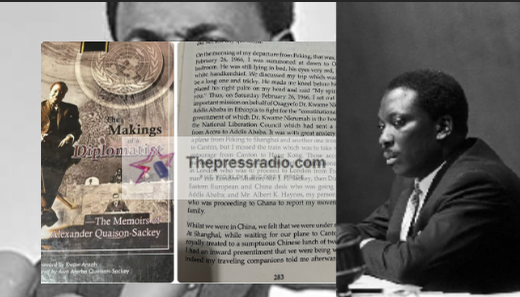
Find and buy the book the next time you are at the bookshop!
Pages 277- 290 specifically addresses this. AQS recounts how things as stated in page 283 eventually resulted in him making a beeline for Accra instead. https://t.co/GTYJ2xxzcs pic.twitter.com/NMSU0sNyb2— Perfume and Prose (@bookpresse) August 20, 2026
Source: Thepressradio.com