
Protecting the president of the United States involves far more than placing armed agents around the head of state. Behind the scenes, the US Secret Service employs a sophisticated system of deception, planning and security measures designed to keep presidents safe while allowing them to carry out their public duties.
A recent report has shed light on what has been described as a “shell game”, a strategy in which security officials carefully manage information about a president’s movements and whereabouts. The objective is to make it difficult for potential attackers or hostile actors to determine exactly where the president will be at any given moment.
The approach is particularly important because US presidents regularly travel to public events, political gatherings, private residences and international destinations. Their movements can attract enormous media attention, making secrecy a major challenge for the agents responsible for their protection.
One of the techniques used by security teams is to create uncertainty around the president’s movements. Rather than allowing outsiders to know precisely which vehicle, route or location the president will use, security planners can employ multiple vehicles, alternative routes and carefully timed movements.
The strategy essentially creates several possibilities for where the president might be, making it considerably harder for someone planning an attack to identify the correct target.
The Secret Service also relies heavily on advance planning. Agents assess venues before presidential visits, identify potential threats and establish secure routes and evacuation plans. Security personnel may be positioned at strategic locations well before the president arrives, while communications between different teams remain tightly controlled.
Presidential travel can therefore involve a much larger operation than what members of the public see on television. A motorcade, for example, may include multiple vehicles serving different security and logistical functions. The visible presidential limousine is only one component of a broader protective operation.
The need for such measures has been demonstrated repeatedly throughout American history. Several US presidents have faced assassination attempts, while four presidents — Abraham Lincoln, James Garfield, William McKinley and John F. Kennedy — were assassinated.
The Secret Service itself was created in 1865, originally to combat widespread counterfeiting of US currency. Presidential protection was added later, following the assassination of President Garfield in 1881, and became a more established responsibility after McKinley’s assassination in 1901.
Today, protecting the president is one of the agency’s most important responsibilities. The Secret Service also protects vice presidents, former presidents and other individuals who qualify for federal protection.
Modern technology has changed presidential security, but the fundamental principle remains the same: potential attackers should not be given enough information to predict where a protected individual will be or how they will move.
The “shell game” concept illustrates why presidential movements can sometimes appear confusing to the public. A president may seem to disappear from view, take an unexpected route or arrive at a location through a different entrance. Such actions are not necessarily accidental; they can form part of a broader effort to make presidential movements unpredictable.
The protective operation also involves coordination between Secret Service agents, local law enforcement, intelligence agencies, military personnel and White House staff. Each group can have a different role in ensuring that a presidential visit proceeds safely.
The challenge has become even greater in the age of social media. Information about presidential movements can spread almost instantly, while photographs, videos and live posts can reveal locations that security teams would prefer to keep confidential.
For this reason, presidential security is increasingly dependent on controlling information as much as controlling physical access.
The Secret Service’s methods demonstrate that protecting a US president is a complex exercise involving planning, intelligence, deception and rapid response. What appears to be a simple presidential appearance can actually involve a carefully coordinated security operation designed to ensure that the president remains visible to the public while his precise movements remain difficult to predict.
Ultimately, the “shell game” is about creating uncertainty. By keeping potential threats guessing about the president’s exact location and movements, security officials seek to reduce opportunities for an attack and give the president the freedom to continue performing the duties of the office.
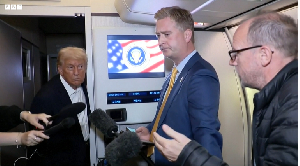
Exclusive: An Iranian assassination threat against President Trump prompted an extraordinary operation in July in which he flew secretly from Turkey on an alternate military aircraft while the White House said he was aboard Air Force One. https://t.co/pDhy28YEmK pic.twitter.com/AcOOidQlfm
— The Washington Post (@washingtonpost) August 11, 2026
Source: Thepressradio.com