

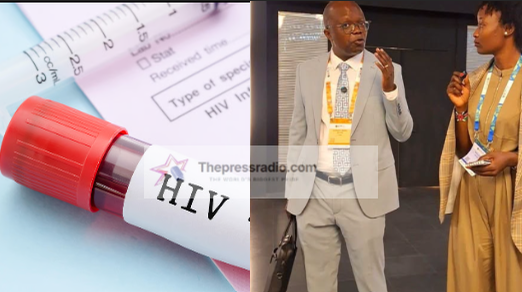
There is currently no cure for HIV, according to Professor Kenneth Ngure, President of the International AIDS Society (IAS).
Speaking during an interview with journalist Aidah Munzatsi, Prof. Ngure, who is also a health researcher, clarified that despite significant advances in HIV treatment and prevention, scientists have not yet developed a cure that can completely eliminate the virus from the body.
He, however, urged people to make use of the HIV prevention methods that are currently available while encouraging people living with HIV to continue taking their prescribed medication.
His comments come at a time when researchers around the world are making progress in developing new ways to prevent and manage HIV.
One of the developments highlighted at AIDS 2026 in Rio de Janeiro was research into a once-weekly HIV treatment combining islatravir and lenacapavir.
According to research presented at the conference, the weekly treatment was able to maintain viral suppression at levels comparable to daily treatment among people whose HIV was already well controlled.
If successfully developed and approved, a once-weekly treatment could offer an alternative to daily medication and potentially make HIV treatment more convenient for some people living with the virus.
However, the treatment remains investigational and should not be regarded as a cure for HIV.
Researchers are also making progress in long-acting HIV prevention. Lenacapavir, for instance, is being developed as an HIV prevention injection capable of providing protection for up to six months.
These developments have raised hopes that future HIV prevention and treatment options could become more convenient and effective.
Despite the progress, health experts continue to stress that people living with HIV should remain on their prescribed treatment. Effective antiretroviral therapy can suppress the virus to very low levels and help people living with HIV maintain their health.
Prevention also remains an important part of efforts to reduce new HIV infections, with health authorities encouraging people to use proven prevention tools and seek reliable information about HIV.
Prof. Ngure’s comments therefore serve as a reminder that advances in HIV research should not be confused with the discovery of a cure.
While researchers continue to explore new treatments, vaccines and prevention methods, there is still no approved treatment that completely eliminates HIV from a person’s body.
The global scientific community continues to work towards better treatment and prevention options, with the ultimate goal of ending HIV as a major public health threat.
People are encouraged to rely on qualified health professionals and trusted health organisations for accurate information about HIV rather than unverified claims circulating online.
Source: Thepressradio.com