

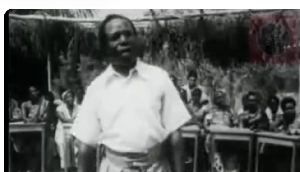
Rare footage showing how English was taught in the former Gold Coast has offered a fascinating glimpse into Ghana’s educational history and the methods used in colonial-era classrooms.
The footage has attracted attention because it provides a visual reminder of a period when formal education was undergoing significant transformation under British colonial rule, with English gradually becoming a central part of the school system.
Historical records show that the teaching of English in the Gold Coast can be traced to colonial schools, where lessons commonly focused on reading, writing and religious instruction. Students learned through repeated reading of primers and spelling books, reflecting the educational methods of the period.
English was particularly important in government schools. Historical research indicates that during the early colonial period, English was taught in government schools following methods used in England. Students were exposed not only to the language but also to stories, ideas and aspects of British culture through the books used in their lessons.
The importance attached to English was closely connected to the development of Western-style education in the Gold Coast. Missionaries established schools as part of their religious activities, while the colonial administration supported aspects of the emerging education system. English became an important requirement in these institutions, helping produce Africans who could serve as teachers, clerks, interpreters and other professionals.
However, the role of English in education was not always straightforward. The colonial education system also generated debates over whether children should first be educated in their own languages before being introduced to English.
A major change came with the 1925 Education Ordinance associated with Governor Gordon Guggisberg. One of the principles of the new education policy stated that although English education should be provided, it should be firmly based on the vernacular.
Under the policy, local languages were given an important role during the early years of primary education, while English became increasingly prominent at later stages. Research on Ghana’s language-in-education history indicates that Ghanaian languages were intended to serve as the medium of instruction during the first three years of primary school, after which English would take a greater role.
The approach reflected an attempt by the colonial authorities to combine English-language education with local languages. Guggisberg’s educational principles also placed emphasis on teacher quality, character development, religious education, organised games and education that responded to local economic and social conditions.
The historical footage is therefore more than a glimpse of an old classroom. It provides context for understanding how language, education and colonial administration became closely connected in the Gold Coast.
Researchers have noted that colonial education had consequences beyond teaching children how to read and write. Education was also used as an instrument of social and cultural influence, with English becoming associated with access to formal education, administration and positions of authority.
Despite the end of colonial rule, English retained its importance after Ghana gained independence in 1957. It remains one of the country’s principal languages of education and public administration.
For many Ghanaians today, the old footage offers an opportunity to compare the classroom experience of an earlier generation with modern teaching methods. It also highlights how dramatically Ghana’s education system and language policies have evolved over the decades.
The footage serves as a reminder that the story of English in Ghana is not simply about the introduction of a foreign language. It is also a story about colonialism, education, cultural identity and the development of the modern Ghanaian state.
Watch the video below:
Rare Footage: How English Was Taught in the Gold Coast, 1954 🇬🇭 | Part 1
Adults were taught spoken English through simple words, repetition and everyday demonstrations. pic.twitter.com/KzGgCetoXN— GHANA FACTS & HISTORY (@GhanaianMuseum) August 11, 2026
Source: Thepressradio.com