

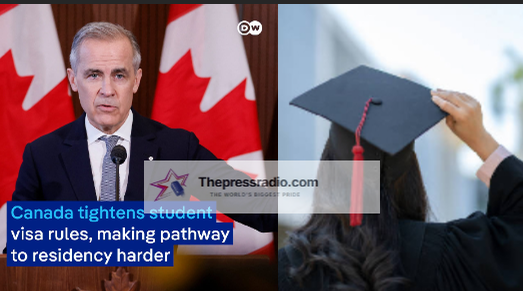
Canada is tightening its international student system, introducing measures that could make it more difficult for some foreign graduates to remain in the country, secure work and eventually qualify for permanent residency.
The changes are expected to affect international students from several countries, including those from Africa who have traditionally viewed studying in Canada as an opportunity to gain an education, obtain employment and potentially settle permanently.
For 2026, the Canadian government has set a target of 408,000 study permits. Of this figure, about 155,000 are expected to be issued to new international students, while the remainder will cover extensions for students already in Canada.
The reduced intake reflects Canada’s broader effort to manage the number of temporary residents entering the country.
Under the tightened system, prospective students are expected to face greater scrutiny when applying for study permits. Financial capacity and the credibility of an applicant’s study plans are becoming increasingly important factors in the application process.
Applicants may need to provide convincing evidence that they have sufficient funds to support themselves while studying and that their proposed course of study makes sense in relation to their academic and career plans.
For students from Ghana and other African countries, the changes could mean that simply gaining admission to a Canadian institution may no longer be viewed as enough to guarantee a smooth pathway to employment and long-term residence.
Post-graduation work opportunities are also becoming more selective.
Access to a post-graduation work permit can depend on factors including the student’s qualification and institution. For graduates from some non-degree programmes, the field of study may also become an important consideration.
This means international students will need to pay closer attention to the type of programme they choose before travelling to Canada.
Students who select programmes without considering their eligibility for post-graduation opportunities could find it more difficult to remain in Canada after completing their studies.
The changes are particularly significant for African students because Canada has become a major destination for international education. Many students have historically considered Canadian education attractive not only because of the country’s universities and colleges but also because of the possibility of gaining Canadian work experience after graduation.
However, the Canadian government is making it clear that studying in the country should not automatically be regarded as a guaranteed route to permanent residency.
The tightening of the system is part of a wider effort by Ottawa to reduce the number of temporary residents in Canada.
Canadian authorities have cited pressure on housing, infrastructure and the labour market as some of the factors behind the changes.
The rapid growth in the number of temporary residents has contributed to concerns about housing availability and affordability in different parts of the country.
By reducing the number of new international students and introducing stricter requirements, the government hopes to bring the temporary-resident population under greater control.
For Ghanaian students considering Canada, the latest measures mean that careful planning is increasingly important.
Prospective applicants should examine the requirements for their preferred programme, understand the financial obligations involved and consider what opportunities may be available after graduation.
Students should also avoid assuming that obtaining a study permit automatically gives them a pathway to permanent residency.
Instead, their prospects after graduation can depend on their qualifications, work experience, language ability, programme and the immigration rules in force at the time.
Canada remains open to international students, but the latest reforms indicate that the government is becoming more selective about who enters the country and what opportunities are available to them afterward.
For students from Ghana and other African countries, the message is clear: studying in Canada remains possible, but the route from education to employment and permanent residency is becoming more competitive and conditional.
Source: Thepressradio.com