

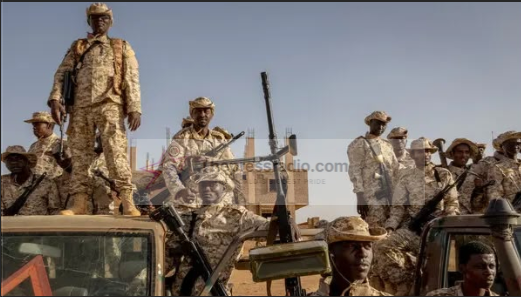
A drone strike blamed on Sudan’s paramilitary Rapid Support Forces (RSF) has killed 41 people at a shelter for displaced civilians in the Blue Nile region, near the Ethiopian border, according to the rights group Emergency Lawyers.
The attack, which reportedly occurred on Friday, October 9, 2026, in the Abu Shandi area of Sudan’s Blue Nile province, has raised fresh concerns about the safety of civilians caught up in the country’s ongoing conflict.
Emergency Lawyers, an organisation that monitors human rights violations and developments in the war, reported that eight children were among those killed in the strike.
The attack also left several people injured, with women and children reportedly accounting for a significant proportion of those affected. The victims were among civilians who had sought refuge in the area after fleeing violence elsewhere in the country.
The reported strike has intensified concerns about the growing use of drones in Sudan’s conflict and the risks faced by displaced families who are already struggling to find safe shelter.
The United Nations Office for the Coordination of Humanitarian Affairs (OCHA) condemned the reported attack and called for accountability for violations of international humanitarian law.
Denise Brown, the UN resident and humanitarian coordinator in Sudan, expressed concern over the civilian casualties and the continuing impact of the conflict on vulnerable communities.
The UN also indicated that the affected area had experienced repeated attacks in recent weeks, forcing residents to flee their homes and exposing more people to insecurity.
The RSF was blamed for the latest drone strike by Emergency Lawyers. However, the paramilitary group had not publicly responded to a request for comment at the time of the report.
The incident comes as Sudan continues to endure a devastating war between the RSF and the Sudanese Armed Forces, which erupted in April 2023 following a breakdown in relations between the two military factions.
The fighting initially centred on the capital, Khartoum, before spreading to other parts of the country, resulting in widespread destruction, civilian deaths and the collapse of essential services in several communities.
Millions of Sudanese have been forced to abandon their homes, with many seeking refuge in other parts of the country or crossing international borders to escape the violence.
The Blue Nile region, which borders Ethiopia, has also faced security challenges as the conflict has expanded beyond its initial centres.
The humanitarian consequences have been severe, with displaced families facing shortages of food, clean water, healthcare and adequate shelter. Children remain particularly vulnerable because of the disruption to education, healthcare and other essential services.
Conflict monitoring figures cited in reports on the war indicate that at least 150,000 people may have been killed since the fighting began, although the actual death toll remains uncertain and could be considerably higher.
More than 12.4 million people have also been forced to flee their homes, making Sudan one of the world’s most serious displacement crises.
The United Nations estimates that 33.7 million people in Sudan will require humanitarian assistance in 2026, underscoring the scale of the emergency facing the country.
The latest reported attack highlights the difficulties humanitarian organisations face in protecting civilians and delivering assistance in areas affected by continued fighting.
Emergency Lawyers has called for accountability over the strike, while the United Nations has reiterated the need to protect civilians and uphold international humanitarian law.
As hostilities continue, the deaths reported in the Blue Nile region have renewed calls for measures to prevent further civilian casualties and improve access to humanitarian assistance for displaced communities.
Source: Thepressradio.com