

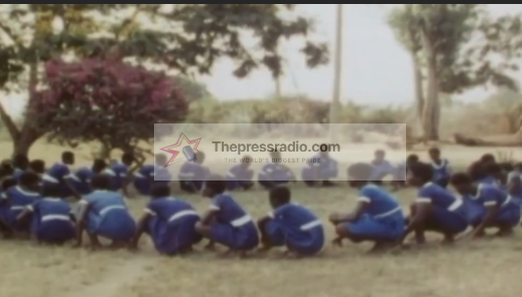
Rare archival footage from 1982 has resurfaced, offering a glimpse into how Ghanaian schoolchildren learned about and celebrated the legacy of the legendary Asante heroine, Yaa Asantewaa.
The footage shows schoolchildren singing songs about Yaa Asantewaa as they play at school, highlighting how her story was passed down to younger generations through music and everyday school activities.
Yaa Asantewaa remains one of the most prominent figures in Ghanaian history. The Queen Mother of Ejisu became widely known for her role in resisting British colonial rule and leading Asante forces during the War of the Golden Stool, also known as the Yaa Asantewaa War, in 1900.
The resurfaced footage provides a rare historical window into the way her story was remembered decades after the conflict.
The children can be seen participating in the singing activity, with the songs centred on Yaa Asantewaa and her courage. The footage has attracted attention because it captures an aspect of Ghanaian childhood and cultural education from more than four decades ago.
Historical accounts describe Yaa Asantewaa as a powerful leader who challenged British attempts to exert greater control over the Asante Kingdom.
Her leadership during the 1900 resistance made her an enduring symbol of courage, leadership and resistance to colonial rule.
Her story has since become part of Ghana’s broader historical and cultural heritage, with her name appearing in educational institutions, monuments, books, songs and other forms of cultural expression.
The 1982 footage is particularly significant because it demonstrates how historical figures were remembered outside formal classroom lessons.
The children singing about Yaa Asantewaa illustrates how songs and oral traditions played a role in transmitting historical knowledge and cultural values to younger generations.
Archival footage such as this also offers an opportunity to compare aspects of Ghanaian school and community life in the early 1980s with contemporary experiences.
At a time when modern digital platforms have become major sources of information and entertainment, the footage serves as a reminder of the important role that music and oral storytelling once played in preserving historical memories.
Yaa Asantewaa’s legacy continues to feature prominently in discussions about Ghanaian history and the role of women in leadership.
Her decision to lead the resistance in 1900 has made her an enduring figure in Ghana’s national history and a source of inspiration for generations.
The newly circulated footage has therefore attracted interest not only because of its historical value but also because it captures young Ghanaians engaging with the story of one of the country’s most recognised historical figures.
The footage provides a snapshot of Ghanaian life in 1982 while showing that the memory of Yaa Asantewaa remained deeply embedded in popular culture and children’s activities.
More than 40 years later, the archival recording offers viewers an opportunity to revisit how Ghana’s history was remembered and celebrated by an earlier generation.
Source: Thepressradio.com