
Ghana’s first President, Dr Kwame Nkrumah, survived a dramatic assassination attempt at the Flagstaff House in Accra on January 2, 1964, after a police officer assigned to presidential security opened fire on him.
The incident remains one of the most notable episodes in Ghana’s political history, highlighting the security challenges Nkrumah faced during his presidency and the death of a security officer who attempted to protect him.
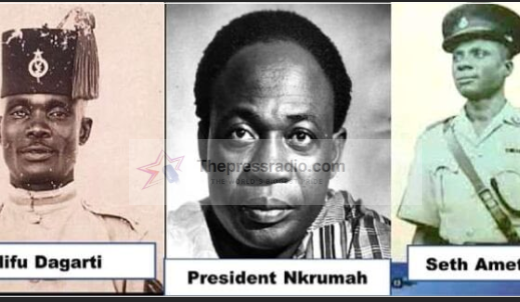
Historical accounts indicate that Nkrumah was preparing to leave the Flagstaff House, then the seat of government, for lunch at Christiansborg Castle in Osu when Police Constable Seth Nicholas Kwame Ametewee, who was on guard duty, fired several shots at him.
Nkrumah was accompanied by security personnel, including his aide-de-camp, Superintendent Salifu Dagarti. When the shooting began, Dagarti moved to protect the president but was fatally shot in the incident.
Despite the danger, Nkrumah survived the attack. Accounts of the incident indicate that he ran towards the kitchen area of the Flagstaff House while calling for help, with Ametewee pursuing him.
The confrontation continued inside the kitchen, where the president and the police constable became involved in a physical struggle. During the encounter, Ametewee reportedly bit Nkrumah on the cheek. Nkrumah managed to fight back, and other officers eventually intervened and subdued the attacker.
Dagarti’s death made the incident particularly tragic. His actions in attempting to protect the president earned him recognition for his service and sacrifice. He was given a state funeral, while the government pledged support for his dependants.
The shooting also raised serious questions about the reliability of the security arrangements around the president. The fact that the alleged attacker was a police officer assigned to guard duty heightened concerns about possible threats from within the security services.
Nkrumah later discussed assassination attempts against him in his book Dark Days in Ghana, published in 1969. In the account, he described the dangers he faced and expressed concerns about the involvement of members of the police and Special Branch in plots against his life.
The January 1964 incident had wider political consequences. It contributed to increased suspicion within the government over the loyalty of security personnel and was followed by significant changes affecting the police and the president’s security arrangements.
Ametewee was prosecuted over the incident and initially sentenced to death. However, subsequent legal proceedings altered the outcome of his case, with the Supreme Court addressing questions surrounding criminal responsibility and the death of Dagarti.
The attack occurred during a tense period in Ghana’s post-independence history, when Nkrumah’s government faced political opposition and repeated security threats. The president had led Ghana to independence from British colonial rule in 1957 and pursued an ambitious programme centred on African unity, national development and economic transformation.
Today, the Flagstaff House kitchen incident remains an important historical episode because of the circumstances surrounding the attack, Nkrumah’s survival and Dagarti’s sacrifice. It also illustrates the political tensions and security concerns that shaped Ghana during the early years of independence.
Today in History🇬🇭: The 1964 Flagstaff House Kitchen Brawl: President Nkrumah vs. Constable Ametewee, and How Supt. Dagarti Died https://t.co/cQwIBZGOy8
— Ghana Crimes Ltd. (@GhanaCrimes) November 12, 2023
Source: Thepressradio.com