
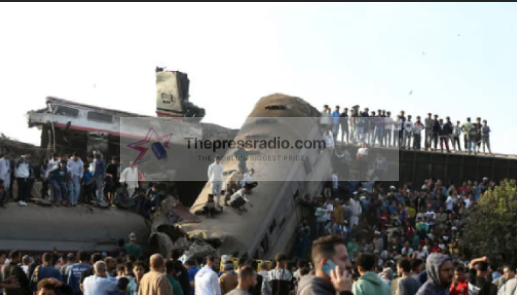
At least seven people have been killed and 125 others injured following a deadly collision involving two passenger trains in Egypt, with survivors recounting terrifying scenes of destruction, panic and confusion after the accident.
The incident occurred on Sunday, November 8, 2026, in the Al-Ayyat district of Giza province, approximately 52 kilometres south of Cairo.
According to Egyptian transport authorities, a passenger train travelling from Giza towards Fayoum collided with the rear of another train travelling from Cairo to Aswan. The second train was reportedly stationary on the same railway track when the collision occurred.
The force of the impact caused several carriages to derail, leaving passengers trapped inside damaged compartments. Some sections of the trains were reportedly severely mangled, making rescue operations difficult.
Egyptian authorities confirmed that seven people died in the accident, including the conductor of one of the trains. At least 125 passengers sustained injuries and were taken to nearby medical facilities for treatment.
Emergency response teams were quickly deployed to the scene, with authorities sending 72 ambulances to transport victims to hospitals. Medical personnel attended to the injured, while rescue workers and other emergency officials worked to assist passengers trapped inside the damaged carriages.
Reports indicated that more than 70 injured passengers had been discharged from hospitals after receiving treatment, while others remained under medical observation.
Survivors described the moments following the collision as terrifying, with passengers struggling to understand what had happened as the train compartments filled with dust and debris.
Farha Gamal, who was travelling aboard the train heading towards Fayoum, recounted witnessing scenes of devastation inside the carriage.
She said she saw passengers who appeared to have died while others struggled to escape from the wreckage. She also described some of the train compartments as severely damaged following the impact.
Other survivors reportedly said the collision generated large amounts of dust, making it difficult for passengers to breathe or see clearly as they attempted to find their way out.
Residents from nearby communities also rushed to the accident scene to assist passengers, helping those who were trapped and contacting emergency services.
The accident has prompted a response from Egypt’s political leadership, with President Abdel-Fattah el-Sissi ordering an investigation into the circumstances surrounding the collision.
The president also directed relevant authorities to ensure that injured passengers receive the necessary medical attention and that all available assistance is provided to affected families.
Egypt’s Public Prosecution has launched an investigation to establish what led to the collision and determine whether negligence, operational failures or other factors contributed to the tragedy.
A specialised technical committee is also expected to examine the damaged trains, railway tracks and operational procedures to help establish the precise cause of the accident.
The investigation is expected to determine why the second train was stationary on the track and whether the railway’s signalling and safety systems functioned properly before the collision.
The tragedy has once again drawn attention to railway safety in Egypt, a country that has experienced several serious train accidents over the years.
Despite government efforts to modernise railway infrastructure and improve safety standards, concerns about maintenance, operational management and passenger protection continue to feature in discussions about the country’s transport system.
One of Egypt’s deadliest railway disasters occurred in 2002, when a fire aboard an overcrowded passenger train killed more than 300 people.
The latest collision has renewed calls for stronger safety measures and improved monitoring of railway operations to prevent similar tragedies.
As investigations continue, families of the victims are awaiting further information about the circumstances that led to the accident, while injured passengers continue to receive medical care.
Source: Thepressradio.com