
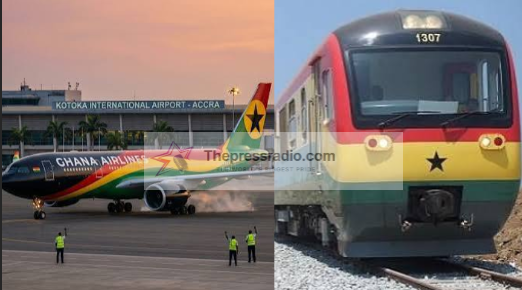
Ghana should channel its limited fiscal resources into building modern intercity and urban rail networks rather than pursuing the establishment of a new national airline, columnist Ras Mubarak has argued in an opinion piece published on November 20, 2026.
Writing on the mounting strain of traffic congestion in the capital, Mubarak notes that thousands of residents lose hours each morning and evening in gridlock where vehicles crawl below 20 kilometres per hour along major corridors. Quoting economic estimates, he points out that traffic congestion costs the country roughly 8 per cent of its Gross Domestic Product translating to about $10.3 billion every year in wasted time, higher transportation expenses, diminished productivity, and excess fuel consumption, particularly within Accra and its surrounding areas. Beyond the financial burden, he emphasizes the human toll, citing heightened stress, worsening air pollution, late arrivals, and soaring housing costs that force families out of neighborhoods close to their workplaces.
According to Mubarak, developing reliable rail links offers a realistic solution because the distances connecting Accra to key surrounding cities are short enough to serve as natural commuter corridors. He highlights that Accra to Nsawam spans roughly 35 to 40 kilometres, Accra to Koforidua is about 60 to 85 kilometres, Accra to Cape Coast covers between 120 and 140 kilometres, and Accra to Ho sits between 140 and 185 kilometres. With standard-gauge trains operating at speeds of 120 to 160 kilometres per hour, daily commuting between these secondary cities and the capital would become both practical and appealing.
He argues that such connectivity would significantly improve living standards for ordinary workers and families. Citing cost-of-living comparisons showing that a one-bedroom apartment in central Koforidua costs roughly half of what is charged in Accra, alongside cheaper food, more affordable land, and cleaner air, Mubarak maintains that dependable, punctual, and affordable train services would enable professionals to live outside the congested capital while remaining fully connected to its economic opportunities.
Against this backdrop, the columnist questions the wisdom of allocating preparatory funds in the 2027 budget toward setting up another national carrier. He notes that establishing and maintaining an airline demands hundreds of millions of dollars for aircraft, operations, training, and likely continuous state support, while offering little benefit to everyday domestic commuters such as civil servants or young families priced out of Accra’s housing market.
Instead, Mubarak urges policymakers to build on existing railway foundations, pointing to operational segments of the Eastern Railway and the commissioned Tema–Mpakadan standard-gauge line. Referencing Ghana Railway Development Authority estimates of around $5 million per kilometre for modern standard-gauge construction and broader African benchmarks ranging between $5 million and $8 million per kilometre he contends that rail investments yield far broader economic returns by creating construction jobs, lowering logistics expenses, reducing road fatalities, and cutting vehicle operating costs.
In the immediate term, functional trains along the Eastern and Central corridors would relieve pressure on Accra’s entry routes and stimulate regional economic activity, building momentum for eventual expansion toward Kumasi, Tamale, Takoradi, and beyond. Over the long term, he adds, a comprehensive rail network would help decongest Accra, support planned growth in secondary cities, improve air quality, and enhance freight movement for agriculture, minerals, and regional trade. Linking this vision to government plans to move 200,000 daily Accra commuters through improved buses and light rail, Mubarak concludes that prioritizing domestic mobility over the prestige of a flag carrier represents the most impactful choice for ordinary Ghanaians.
Source: Thepressradio.com