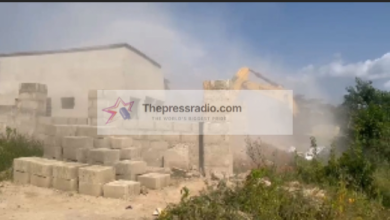

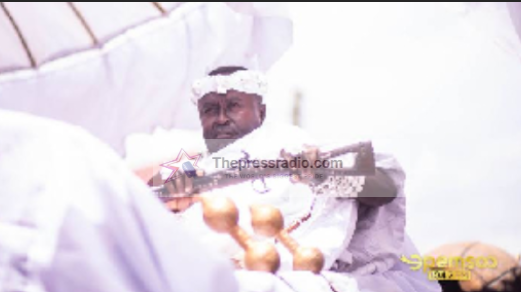
The Omanhene of the Agona Traditional Area in the Ashanti Region, Obirikomfo Anokye Boakye II, has reportedly barred the Member of Parliament for Afigya Sekyere East, Mavis Nkansah-Boadu, from organising social events within his traditional jurisdiction following a disagreement over an invitation letter.
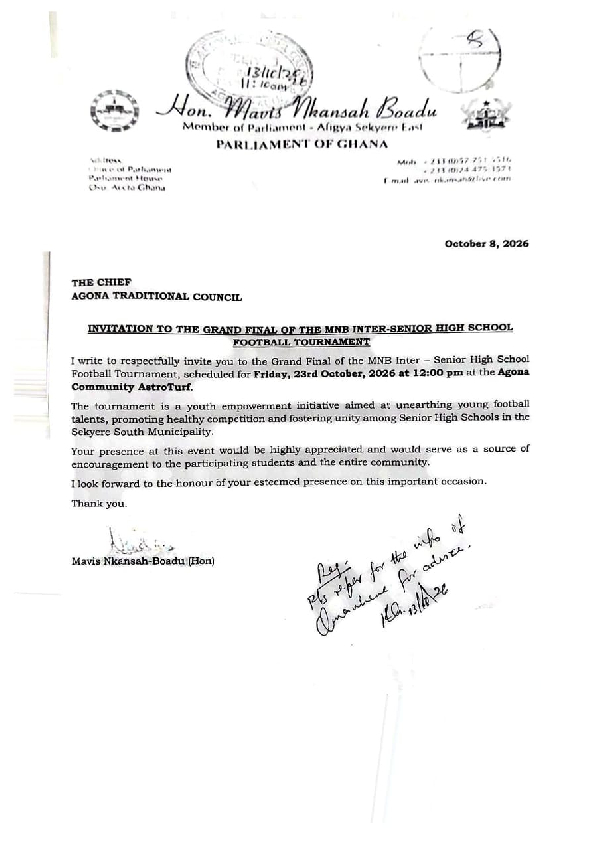
The dispute reportedly arose from a letter dated October 8, 2026, inviting the traditional ruler to the grand finale of the MNB Inter-Senior High School Football Tournament, an event associated with the MP.
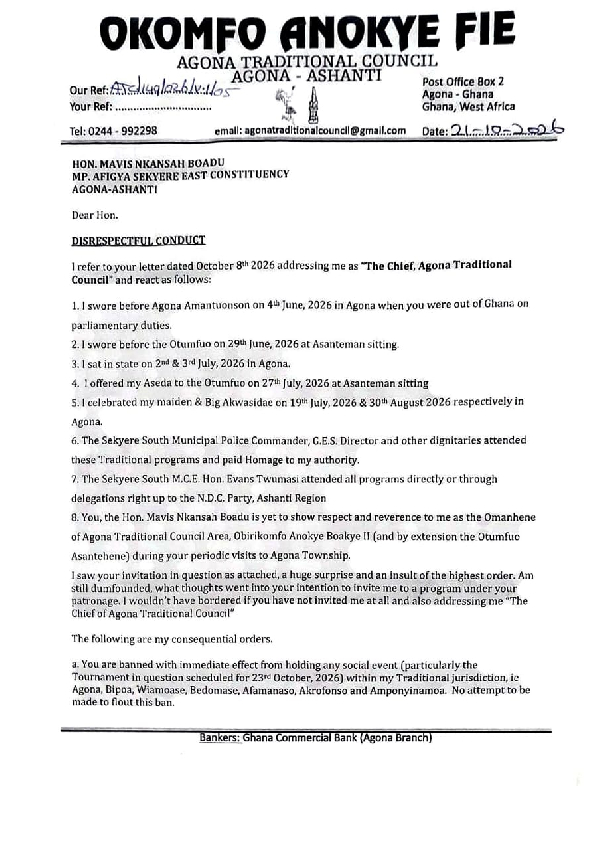
According to reports, the chief took issue with the form of address used in the correspondence, which referred to him as “The Chief, Agona Traditional Council.” He reportedly considered the wording inappropriate because, in his view, it failed to recognise his status as the Omanhene of the traditional area.
The disagreement has since developed into a dispute over traditional protocol and the recognition of customary authority.
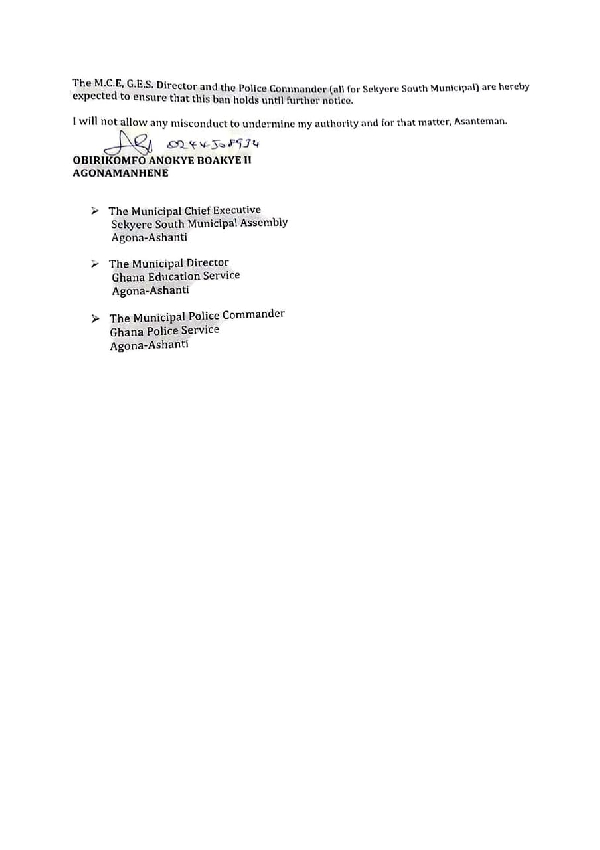
Obirikomfo Anokye Boakye II reportedly announced that the MP was prohibited from organising social events within his jurisdiction. The directive also reportedly affected plans for the football tournament’s grand finale, which was scheduled for October 23, 2026.
The affected communities were identified as Agona, Bipoa, Wiamoase, Bedomase, Afamanaso, Akrofonso and Amponyinamoa. The directive places the dispute within a wider traditional area rather than limiting it to a single event venue.
Traditional leadership in Ghana often involves established protocols governing communication with chiefs, including the use of titles and forms of address in official correspondence. Such protocols can carry considerable cultural significance, particularly when a letter is perceived to overlook a chief’s recognised position.
The controversy surrounding the invitation therefore highlights the importance of observing customary procedures when engaging traditional authorities. It also raises questions about how disagreements involving public officials and traditional leaders can be resolved without disrupting community activities.
For the MP, the reported restriction could affect the organisation of events within the area, particularly those requiring the use of land under the traditional authority’s jurisdiction. The football tournament’s final was intended to bring together students and other stakeholders through sporting competition.
However, the full implications of the chief’s directive, including whether further discussions have taken place between the parties, were not independently confirmed in the information available for this report.
The dispute also underscores the relationship between elected representatives and traditional authorities, whose roles differ but can intersect in matters involving community development, cultural practices and public events.
While Members of Parliament represent their constituents through the country’s political system, traditional leaders retain important customary responsibilities within their respective areas. Cooperation between the two sides can be important when organising community programmes and other public activities.
Further clarification from the parties involved would help establish whether the disagreement can be resolved and whether the planned tournament finale or other activities will be affected.
Source: Thepressradio.com