

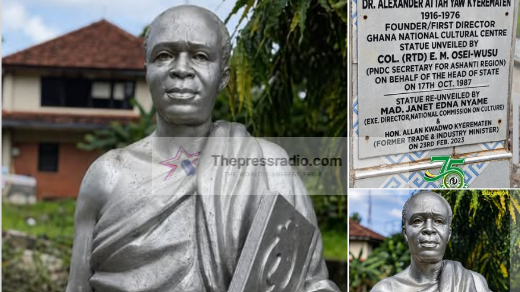
The Centre for National Culture in Kumasi, Ashanti Region, stands as an important institution in Ghana’s efforts to preserve, promote and showcase its cultural heritage, particularly the traditions and history of the Asante people. As the institution prepares to mark its 75th anniversary in November 2026, its history highlights the vision of its founder, the support of traditional leadership and the continuing importance of protecting Ghanaian culture.
The origins of the centre date back to the early 1950s, when Dr Alexander Atta Yaw Kyerematen proposed the establishment of the Asante Cultural Centre. His vision was to create a dedicated space where Asante history, customs, traditional arts and cultural practices could be preserved and passed on to future generations.
The initiative received the backing of Otumfuo Sir Osei Agyeman Prempeh II, the Asantehene at the time, and the Asanteman Council. Their support helped advance the idea of creating an institution that would serve as a centre for cultural education, historical preservation and the promotion of Asante identity.
The original concept went beyond a conventional museum. Plans for the facility included a library, a traditional chapel, an exhibition hall, a theatre, a dance arena and a museum. Together, these proposed facilities were intended to provide opportunities for visitors to learn about and experience Asante traditions through historical objects, artistic displays and cultural performances.
The centre officially opened in 1956, marking an important milestone in the development of cultural institutions in Kumasi. During the ceremony associated with the museum, Otumfuo Sir Osei Agyeman Prempeh II laid the foundation stone for one of its major attractions, known as the Traditional House for the Ashanti Museum and Art Gallery.
The museum later became known as the Prempeh II Jubilee Museum. It remains an important part of the centre’s historical identity, housing artefacts that help tell the story of Ghana’s cultural past and preserve aspects of Asante history for future generations.
In 1963, the institution was renamed the National Cultural Centre under the government of Ghana’s first president, Dr Kwame Nkrumah. The change reflected a broader national approach to cultural development, moving beyond an exclusive focus on Asante heritage to promote the diverse cultural traditions of Ghana as a whole.
Despite the change in name, the Kumasi centre continued to maintain its connection to Asante history and traditions. Its activities remained part of wider efforts to provide a platform for cultural expression, traditional arts, crafts and heritage education.
In 1990, the institution adopted the name Centre for National Culture as part of changes within Ghana’s cultural administration and the decentralisation framework under the Provisional National Defence Council government. The new designation reflected the wider structure for managing and promoting culture across the country’s regions.
Over the decades, the Kumasi Centre for National Culture has remained a significant place for cultural learning, artistic expression and the preservation of historical artefacts. Its story also demonstrates how traditional authorities, cultural advocates and public institutions can work together to protect a community’s heritage.
As the centre approaches its 75th anniversary in November 2026, the milestone offers an opportunity to reflect on Dr Alexander Atta Yaw Kyerematen’s original vision, the support of Otumfuo Sir Osei Agyeman Prempeh II and the Asanteman Council, and the institution’s continuing role in Ghanaian cultural life.
Preserving history requires more than remembering dates and names. It also involves protecting historical sites, maintaining cultural institutions and ensuring that younger generations have opportunities to understand and appreciate the traditions that have shaped their communities. The history of the Kumasi Centre for National Culture remains a reminder that cultural heritage is an important part of Ghana’s identity and deserves to be safeguarded for generations to come.
Source: Thepressradio.com