

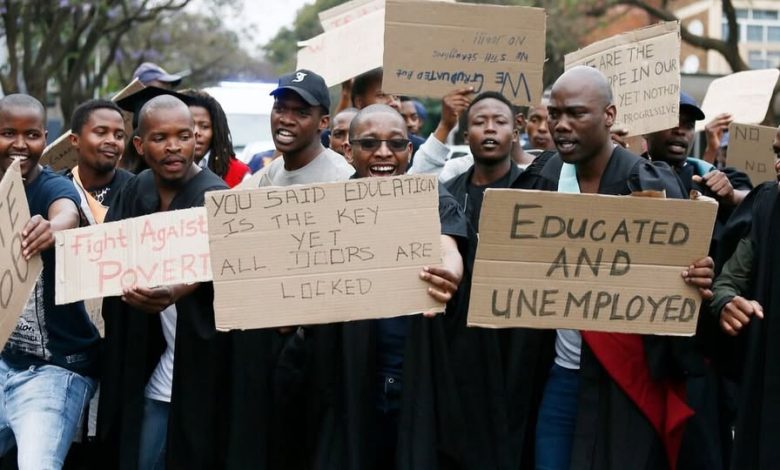
South Africa’s unemployment crisis has worsened, with the country’s official unemployment rate rising to 33.6% in the second quarter, up from 32.7% in the first quarter.
The latest figures from Statistics South Africa (Stats SA) paint a worrying picture of a labour market struggling to create enough jobs for the growing number of people seeking employment.
According to Stats SA, the number of unemployed people increased by 345,000 to 8.5 million during the quarter. At the same time, employment declined by 16,000, leaving approximately 16.7 million people employed.
The country’s labour force nevertheless expanded by 329,000 people during the period. This means that more people entered the labour market looking for opportunities while the number of available jobs actually decreased.
The figures highlight a major challenge for South Africa: the economy is not creating employment at a sufficient pace to absorb new entrants into the workforce.
For millions of South Africans, particularly young people, finding stable employment remains one of the country’s most pressing economic challenges. The latest increase in unemployment could place additional pressure on households already struggling with the high cost of living.
There was, however, a decline in the number of discouraged work seekers during the quarter. Stats SA reported that this group fell by 227,000 to 3.7 million.
While that decline could suggest that some people who had previously stopped looking for work have re-entered the labour market, broader measures of labour underutilisation remain extremely high.
The combined rate of unemployment and time-related underemployment increased to 36.6%. An even broader measure, which includes unemployment, underemployment and people who are available to work but are not actively seeking employment, stood at 46.3%.
This means that almost half of South Africa’s extended labour force remains underutilised.
The figures come against a challenging economic backdrop. Independent economist John Loos pointed to several factors that may have affected job-creation sentiment during the period.
He noted that while there had been some improvement in economic growth during the first quarter, the second quarter was affected by rising inflation, driven in part by higher fuel prices. The country also experienced its first interest-rate increase at the May Monetary Policy Committee meeting.
Higher fuel prices and interest rates can place additional pressure on businesses and consumers, potentially affecting investment, household spending and the willingness or ability of companies to expand their workforce.
The latest unemployment figures therefore present policymakers with a difficult challenge. Economic growth needs to translate more effectively into jobs, particularly as thousands of new workers continue to enter the labour market.
Creating employment will require sustained economic growth, greater investment and conditions that encourage businesses to expand and hire more workers. Addressing barriers faced by small businesses and improving opportunities for young people will also remain critical.
The second-quarter unemployment figures are a stark reminder that South Africa’s economic challenge is not simply about producing growth figures. The country must ensure that growth creates meaningful opportunities for people who need jobs.
With 8.5 million people officially unemployed and the broader labour underutilisation rate reaching 46.3%, the pressure to accelerate job creation has never been more urgent.
Source: Thepressradio.com


