
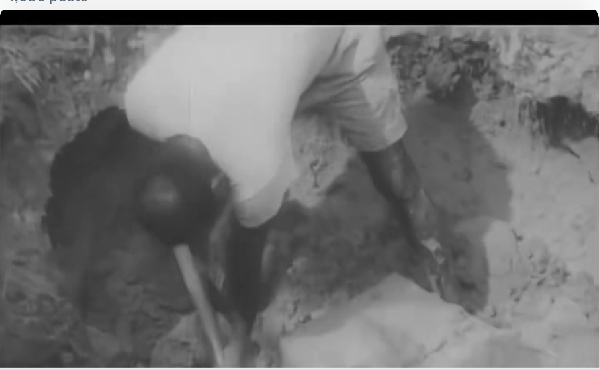
Rare historical footage showing the exhumation of the remains of Ghanaian independence activist Emmanuel Odarkwei Obetsebi-Lamptey has resurfaced, offering a remarkable visual record of an important moment in the country’s history.
Obetsebi-Lamptey was one of Ghana’s revered Big Six, the group of political figures whose activities played an important role in the country’s struggle for independence.
The footage shows his remains being exhumed from Nsawam before they were taken to Osu Cemetery in Accra for a proper reburial. Historical records indicate that his body was initially buried at Nsawam after his death in 1963.
Obetsebi-Lamptey died on January 29, 1963, after suffering from cancer while in detention at Nsawam Prison. His death came during a politically turbulent period under the government of Ghana’s first president, Kwame Nkrumah.
Following his death, his remains were not initially released to his family and he was buried near the Densu River in Nsawam. Years later, after the political changes of the mid-1960s, his remains were exhumed and reburied at Osu Cemetery.
The resurfaced footage has attracted interest because very few visual records exist showing such moments from Ghana’s early post-independence history.
Obetsebi-Lamptey’s contribution to Ghana’s independence movement dates back to the activities of the United Gold Coast Convention (UGCC), which he helped establish. He was also among the six prominent nationalists detained following the 1948 disturbances in the Gold Coast.
The group later became known as the Big Six and remains an important part of Ghana’s independence history.
Known affectionately as “Liberty Lamptey,” Obetsebi-Lamptey was a lawyer, politician and outspoken nationalist. His political activities and opposition to colonial rule helped establish his place among the prominent figures associated with Ghana’s journey towards independence.
The footage of his exhumation therefore provides more than a glimpse into a burial ceremony. It offers a rare connection to a period when Ghana was undergoing major political and social changes.
His eventual reburial at Osu Cemetery also restored a sense of dignity to the final resting place of one of the country’s most prominent independence-era figures.
Today, Obetsebi-Lamptey’s name remains associated with Ghana’s political history, with monuments and landmarks in Accra bearing his name.
The resurfacing of the 1967 footage has consequently renewed public interest in his life, his contribution to Ghana’s independence struggle and the circumstances surrounding his death and subsequent reburial.
For historians and younger generations alike, such archival footage provides a valuable opportunity to revisit Ghana’s past and better understand the people and events that shaped the country’s history.
Rare footage of Emmanuel Obetsebi-Lamptey, one of Ghana’s Big Six, being exhumed at Nsawam and given a proper burial at Osu Cemetery in 1967. He had died in detention at Nsawam Prison on 29 January 1963 after being detained over alleged involvement in plots against President… pic.twitter.com/ukRnQNio9z
— GHANA FACTS & HISTORY (@GhanaianMuseum) August 15, 2026
Source: Thepressradio.com