
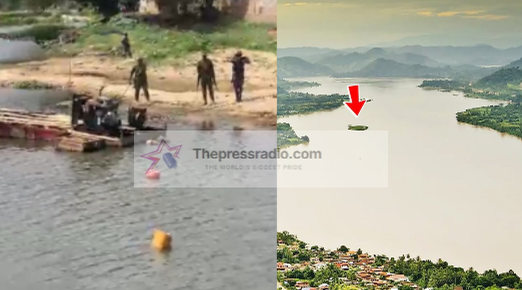
Military personnel have destroyed a Changfan machine found operating on the Densu River at Tetegu near Weija in the Greater Accra Region.
The operation, which took place on Friday, September 4, 2026, has sparked discussions over activities being carried out along the river and the authority under which the dredging operation was being conducted.
The machine was reportedly being used for dredging activities on the Densu River. However, its destruction by the military has raised questions after a representative of the Weija Gbawe Municipal Assembly claimed that the activity had been authorised by the local assembly.
Wilfred Ayitey Blankson, the Presiding Member of the Weija Gbawe Municipal Assembly and Assembly Member for the Weija Electoral Area, said the assembly was aware of the dredging operation.
According to him, the activity was not intended to facilitate illegal mining, commonly referred to as galamsey, but rather to remove accumulated silt from the river.
He explained that the dredging was considered necessary because of the build-up of silt in the Densu River, which can contribute to flooding in communities along the waterway, particularly during periods of heavy rainfall.
The development comes amid intensified efforts by Ghanaian authorities to clamp down on illegal mining activities and the use of Changfan machines on the country’s rivers.
Changfan machines have become a major concern in the fight against illegal mining because of their use in extracting materials from riverbeds. Authorities have been conducting operations across several parts of the country to remove such equipment from waterways.
The Densu River is particularly important because it feeds the Weija Dam, a major source of treated water for communities in parts of the Greater Accra Region. Environmentalists and water-sector stakeholders have repeatedly raised concerns about activities that could threaten the quality and sustainability of the river.
The latest incident therefore presents a dispute over whether the machine was being used for legitimate dredging or an activity that required enforcement action.
While the Assembly has maintained that it had knowledge of and approved the dredging work, the military’s decision to destroy the machine has created uncertainty about the circumstances surrounding the operation and whether all the necessary approvals were in place.
The incident is expected to fuel further discussions about coordination between local authorities and security agencies when dealing with activities along environmentally sensitive waterways.
As authorities continue their campaign against illegal mining, stakeholders are also likely to demand clearer guidelines on legitimate dredging operations to prevent authorised environmental projects from being mistaken for illegal mining activities.
Further clarification from the relevant security and environmental authorities could help establish the exact circumstances that led to the destruction of the Changfan machine.
Source: Thepressradio.com