

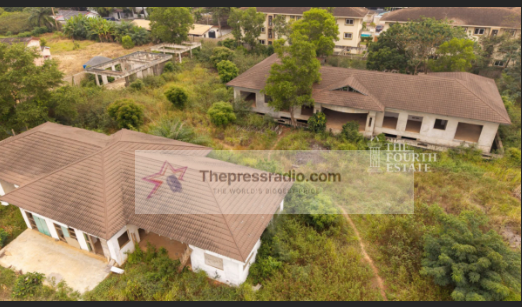
A government project intended to provide an official residence for Ghana’s Vice-President in Cantonments, Accra, has remained incomplete for more than a decade, raising questions about the management of public infrastructure and investment.
The project, located in the Cantonments area of Accra, was initiated several years ago with the objective of providing a dedicated official residence for the Vice-President.
However, approximately 13 years after the project began, the development has reportedly not been completed and has remained largely unused.
The prolonged delay has brought renewed attention to the fate of government projects that are started with public resources but remain unfinished for extended periods.
The Vice-President’s official residence was expected to serve an important institutional purpose by providing suitable accommodation for the occupant of the second-highest executive office in the country.
Despite that objective, successive administrations have continued without the Cantonments project being brought to completion.
The situation has also raised questions about the cost of leaving a major government development unfinished for such a long period. Apart from the resources already invested in construction, prolonged abandonment can expose buildings and other infrastructure to deterioration, potentially increasing the cost of rehabilitation or completion.
The Cantonments project is part of a broader conversation in Ghana about abandoned and delayed public developments. Across the country, several government-funded projects have faced delays because of issues including changes in administration, funding constraints, contractual disputes and shifting government priorities.
In the case of the Vice-President’s residence, the extended period without completion has drawn attention because of the importance of the intended facility and its location in one of Accra’s prominent residential areas.
The condition of the project has consequently prompted renewed discussion about whether unfinished government developments should be reviewed and prioritised for completion where they continue to serve a legitimate public purpose.
Completing such projects could also help prevent public investments from losing value through prolonged disuse.
At the same time, any decision to resume construction would require authorities to assess the current condition of the structure, the amount already spent, the remaining cost and whether the original design and purpose remain appropriate.
The Cantonments residence therefore remains an example of the challenges surrounding long-delayed public projects in Ghana.
With the development reportedly still incomplete after about 13 years, attention is likely to remain on what ultimately happens to the property and whether authorities will take steps to complete, repurpose or otherwise address the long-standing project.
Source: Thepressradio.com


