
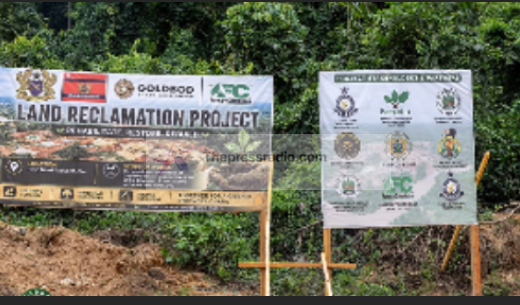
The Ghana Armed Forces Engineer Regiment is set to lead a GH¢35 million land reclamation project aimed at restoring portions of the Tano Nimri Forest Reserve damaged by illegal mining activities.
The initiative, financed by the Ghana Gold Board (GoldBod), is intended to rehabilitate degraded land, stabilise abandoned mining sites and prepare affected areas for reforestation as part of efforts to address the environmental impact of galamsey.
The initial phase of the project will focus on 50 hectares of degraded land within Compartment 161 of the forest reserve. The operation will involve engineering works to restore the terrain and reduce the environmental risks associated with abandoned mining pits.
Under the project’s financial arrangements, approximately GH¢27.9 million has been allocated to engineering works, while GH¢7.2 million is earmarked for afforestation activities over a ten-year period.
The military engineers are expected to undertake several activities, including filling abandoned mining pits, reshaping uneven ground, stabilising the land and levelling affected areas. Drainage channels will also be constructed to help control water movement and reduce soil runoff into nearby water bodies.
These interventions are intended to make the affected land safer and more suitable for ecological restoration. Abandoned mining pits and unstable ground can complicate rehabilitation efforts, while uncontrolled runoff may carry sediment into rivers and surrounding ecosystems.
GoldBod has reported that illegal mining contributed to the destruction of approximately 192.4 hectares of woodland in the area between 2021 and 2024, underscoring the scale of the environmental damage the reclamation initiative seeks to address.
The project forms part of broader efforts to restore landscapes affected by illegal mining, which has caused extensive damage to forests, agricultural land and water resources in parts of Ghana.
Following the completion of the engineering phase, the Forestry Commission is expected to oversee reforestation activities. These will include planting and nurturing indigenous vegetation to help restore the ecological functions of the degraded landscape.
The ten-year afforestation component is intended to support the long-term recovery of the reclaimed area rather than ending the intervention immediately after the earthworks are completed. The survival and growth of newly planted trees will be important indicators of the project’s environmental impact.
The involvement of the Ghana Armed Forces Engineer Regiment brings specialised engineering capacity to the operation, while GoldBod’s financial support and the Forestry Commission’s role are expected to provide complementary resources for rehabilitation and forest management.
The initiative also highlights the need for sustained monitoring after reclamation. Filling pits and reshaping land are important steps, but lasting restoration will depend on effective vegetation management, erosion control and protection against renewed illegal mining.
Although the first phase covers 50 hectares, the reported woodland destruction in the wider area indicates that environmental recovery may require continued interventions and enforcement measures.
The GH¢35 million operation is expected to provide a structured approach to rehabilitating the affected forest land and supporting its gradual return to a healthier ecological condition.
Source: Thepressradio.com