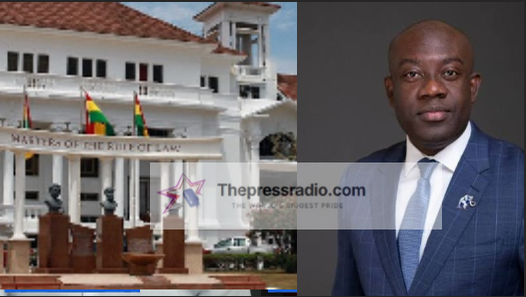
The Supreme Court has dismissed an interlocutory injunction application filed by Ofoase-Ayirebi Member of Parliament Kojo Oppong Nkrumah, clearing the way for selected criminal trials to continue during Ghana’s ongoing legal vacation.
Justice Gabriel Pwamang, sitting as a single judge of the Supreme Court, dismissed the application on Friday, August 21, 2026. The ruling means that the selected High Court judges authorised to sit during the vacation can continue hearing the affected criminal cases.
Oppong Nkrumah had asked the apex court to suspend the operation of administrative warrants issued by Chief Justice Paul Baffoe-Bonnie. The warrants permit selected High Court judges to continue hearing certain criminal matters during the legal vacation, which runs from August 1 to September 30.
The MP’s legal challenge is based on broader constitutional questions concerning the Chief Justice’s authority to issue the warrants and the manner in which discretionary powers are exercised.
Oppong Nkrumah argues that the decision to select particular criminal cases for hearing during the vacation raises concerns under the 1992 Constitution, including provisions relating to equality and the exercise of discretionary powers.
His legal team had therefore sought an interlocutory injunction to preserve the situation until the Supreme Court could determine the substantive constitutional case.
During proceedings, counsel for Oppong Nkrumah, Frank Davies, argued that allowing the selected trials to continue could potentially affect the rights of accused persons, particularly in circumstances where their lawyers may not be available during the legal vacation.
The opposing side, represented by Deputy Attorney-General Dr Justice Srem-Sai, urged the court to reject the injunction application.
The Deputy Attorney-General argued that the application improperly combined the Chief Justice’s administrative responsibilities with the judicial discretion of individual High Court judges handling cases.
The legal dispute has attracted considerable attention because of the implications it could have for the administration of justice during the court’s annual legal vacation.
Although courts generally observe the legal vacation period, the Chief Justice’s warrants allowed selected judges to continue hearing criminal cases.
Some of the cases affected include proceedings involving former National Signals Bureau Director-General Kwabena Adu-Boahene and his wife, Angela Adjei-Boateng, as well as former National Food Buffer Stock Company Chief Executive Officer Hanan Abdul-Wahab and others.
The issue became particularly significant after some of the affected proceedings were adjourned while the Supreme Court considered Oppong Nkrumah’s application.
The latest ruling removes the immediate injunction sought by the MP, meaning the selected criminal proceedings can now continue under the warrants issued by the Chief Justice.
However, the Supreme Court’s dismissal of the injunction does not settle the main constitutional case filed by Oppong Nkrumah.
The substantive case challenging the constitutionality of the Chief Justice’s administrative warrants remains before the Supreme Court. The court will therefore still have to determine whether the arrangements directing selected judges to sit during the legal vacation comply with the 1992 Constitution.
Oppong Nkrumah’s legal team has indicated that it will study the full reasoning of the court before determining its next steps.
The ruling is therefore not the final word on the broader constitutional dispute. Rather, it determines whether the requested interim suspension should be granted while the substantive case remains pending.
For now, the decision allows the affected criminal trials to proceed during the legal vacation, while the wider constitutional questions surrounding the Chief Justice’s powers remain to be determined.
The case could ultimately provide further clarification on the limits of administrative discretion within Ghana’s judicial system and the circumstances under which selected criminal proceedings may continue during the legal vacation.
Source: Thepressradio.com