

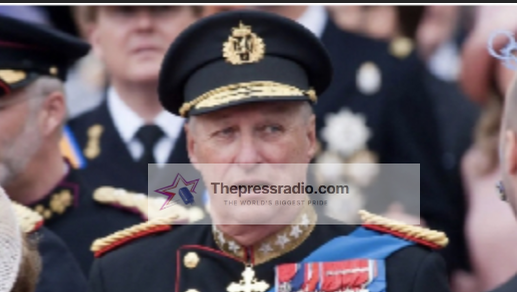
King Harald V of Norway has died at the age of 89, bringing an end to a reign that lasted more than 35 years and saw him become one of Europe’s longest-serving monarchs.
The Norwegian Royal Court announced that the King died peacefully at Oslo University Hospital on Friday, August 28, 2026, at 6:35 a.m. local time. He had been receiving medical treatment in hospital before his death.
Harald had been admitted to hospital on August 17 after suffering from haemolytic anaemia, a blood disorder. His condition became increasingly serious in the days leading up to his death, prompting members of the royal family to gather at his bedside.
Born on February 21, 1937, Harald became King of Norway in January 1991 following the death of his father, King Olav V. He remained on the throne for over three decades and became widely known for his accessible personality, emphasis on national unity and efforts to modernise the Norwegian monarchy.
Harald was the first Norwegian-born prince in several centuries. During the Second World War, he and his family were forced to leave Norway following the German invasion. The young prince eventually spent part of his childhood in the United States before returning to Norway after the war.
Before becoming king, Harald studied social sciences, history and economics at Balliol College, Oxford, and completed military service in Norway.
He also became known internationally for his passion for sailing. Harald represented Norway at three Olympic Games and remained involved in the sport for much of his life. He was also associated with environmental causes and supported efforts to protect the natural environment.
One of the defining moments of Harald’s personal life was his marriage to Sonja Haraldsen in 1968. Sonja was a commoner, and the couple’s relationship challenged traditional expectations surrounding royal marriages at the time.
They were married for almost 58 years and had two children, Crown Prince Haakon and Princess Märtha Louise. Harald is also survived by six grandchildren.
As monarch, Harald became particularly admired for his role during periods of national difficulty. Following the 2011 terrorist attacks in Norway, he delivered messages of unity and compassion that strengthened his reputation as a symbolic figure who sought to bring the country together during moments of crisis.
His reign also saw the Norwegian monarchy become more open and less formal, with Harald frequently speaking about tolerance, diversity and the importance of accepting people from different backgrounds.
Despite his popularity, the Norwegian royal family faced several controversies and challenges in Harald’s later years. The King himself also experienced a number of health problems and underwent several periods of medical treatment.
Harald nevertheless repeatedly rejected suggestions that he should abdicate. He maintained that the commitment he had made to serve as king was a lifelong responsibility.
Following his death, his only son, Crown Prince Haakon, has succeeded him on the Norwegian throne. Haakon, 53, had already served as regent during periods when his father’s health prevented him from carrying out official duties.
The transition marks a new chapter for Norway’s monarchy after more than three decades under Harald’s leadership.
King Harald’s death has prompted tributes from across Norway and renewed reflection on his long public service. He leaves behind a legacy centred on national unity, modernisation and a close relationship with the Norwegian people.
For many Norwegians, Harald was regarded as a down-to-earth and approachable monarch who helped maintain public confidence in the institution during a period of significant social and political change.
His 35-year reign now comes to an end, with the Norwegian crown passing to the next generation.
Source: Thepressradio.com