

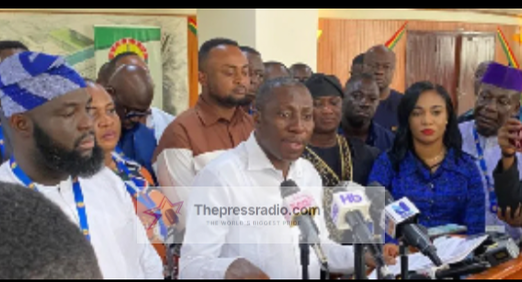
The Minority Caucus in Parliament has boycotted the vetting of three nominees for appointment to Ghana’s Supreme Court, citing concerns over the timing and urgency of the exercise.
The decision was taken by members of the Minority on Parliament’s Appointments Committee during proceedings on Thursday, August 27, 2026. The development followed the caucus’s earlier call for the vetting to be deferred.
The three nominees scheduled to appear before the committee are Justice Sophia Rosetta Oduokuma Bernasko-Essah, Justice Edward Amoako Asante and private legal practitioner Anthony Forson Jnr.
Justice Bernasko-Essah and Justice Amoako Asante are serving Justices of the Court of Appeal, while Forson is a private legal practitioner and former President of the Ghana Bar Association.
Minority Leader Alexander Afenyo-Markin had argued that there was no immediate vacancy on the Supreme Court requiring the nominations to be processed within a short period.
According to the Minority’s position, the Supreme Court is currently functioning with its full complement of justices and continues to hear cases and deliver judgments. Afenyo-Markin therefore questioned why Parliament should be required to rush through the vetting process.
He maintained that the Appointments Committee could conduct the exercise in September and submit its report when Parliament resumes in October.
The Minority Leader also rejected the suggestion that the ongoing judicial vacation created an emergency requiring the nominees to be vetted immediately. He argued that the Supreme Court remains operational and is capable of dealing with matters requiring urgent attention.
The caucus consequently decided not to participate in the vetting of the three Supreme Court nominees.
The boycott adds a political dimension to the latest parliamentary vetting exercise and could lead to further discussions between the two sides of the House over the appropriate timing for the nominations.
The Minority’s position, however, does not extend to all nominees currently before the Appointments Committee. Afenyo-Markin indicated that the caucus would support the prompt vetting of two ministerial nominees whose appearances before the committee were also scheduled.
These are Bawku Central MP Mahama Ayariga, who has been nominated as Minister-designate for Local Government, Chieftaincy and Religious Affairs, and Klottey Korle MP Dr Zanetor Agyeman-Rawlings, who has been nominated as Minister-designate for Environment, Science and Technology.
The disagreement over the Supreme Court nominees comes amid wider discussions about the role of Parliament in scrutinising presidential nominations.
The Appointments Committee is responsible for examining nominees and assessing their qualifications, experience and suitability before its recommendations are submitted to the full House.
For the three judicial nominees, their vetting would have provided an opportunity for members of the committee to question them on issues concerning the judiciary, judicial administration, constitutional matters and the administration of justice.
The Minority’s decision to boycott the exercise means that the disagreement over the timing of the process will remain a key issue as Parliament considers the nominations.
Whether the caucus will participate in a later vetting session or maintain its position will depend on how the matter is handled by the Appointments Committee and Parliament.
For now, the boycott has placed the proposed appointments of the three Supreme Court nominees at the centre of a fresh parliamentary dispute.
Source: Thepressradio.com


