

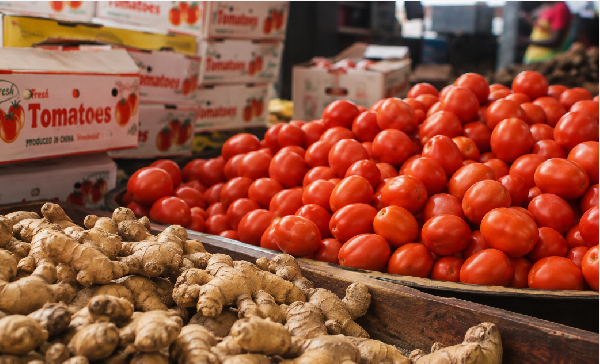
Ghana’s growing dependence on imported tomatoes and ginger is putting additional pressure on the country’s import bill, with researchers from the Council for Scientific and Industrial Research (CSIR) warning that urgent measures are needed to strengthen domestic production.
According to a recent report, Ghana spends more than US$230 million every year on tomato imports, highlighting the scale of the gap between local production and domestic demand. The situation has become a major concern for agricultural researchers, who say increased investment in research, improved farming technologies and stronger support for farmers are necessary to reverse the trend.
The ginger sector is facing an even more severe challenge. A disease outbreak that affected ginger farms has significantly reduced domestic production, leaving Ghana reportedly about 99 per cent dependent on imported ginger.
The development has raised concerns about Ghana’s ability to produce some of its most important food and cash crops locally. Heavy reliance on imports also exposes consumers to international price fluctuations, exchange-rate pressures and disruptions in global supply chains.
For tomatoes, the problem is particularly significant because the crop is widely consumed in Ghana and forms an important part of the country’s food culture. Yet local farmers continue to struggle with low productivity, inadequate irrigation, pests and diseases, limited access to improved seeds and post-harvest losses.
Recent agricultural initiatives demonstrate the scale of the challenge. Ghana’s annual tomato requirement has been estimated at about 805,000 metric tonnes, while local production is around 510,000 metric tonnes, leaving a deficit of nearly 300,000 tonnes that is often supplied through imports.
Researchers and agricultural officials have consequently called for greater use of improved varieties and modern production methods. CSIR’s Crop Research Institute has, for example, launched a climate-smart greenhouse project aimed at improving tomato yields through better varieties, disease-resistant lines and greenhouse technology.
The initiative is expected to help farmers overcome some of the challenges associated with traditional tomato cultivation. Greenhouse production can offer greater control over growing conditions while reducing exposure to certain pests and diseases.
There have also been efforts to increase the availability of locally produced tomatoes during periods of shortage. In January 2026, more than 240 tonnes of fresh tomatoes from the Upper East Region were supplied to markets in Accra as part of an initiative aimed at addressing seasonal shortages and reducing dependence on imports.
For ginger, however, restoring production will require particular attention to disease management. Researchers will need to help farmers identify resistant varieties, improve farm practices and adopt measures capable of preventing future outbreaks from devastating the crop.
The CSIR has consistently emphasised the importance of linking agricultural research with practical support for farmers. Its leadership has argued that technology alone cannot transform Ghana’s agricultural sector without investment and policies that allow farmers to access and use those technologies effectively.
Improved agricultural research could also create opportunities beyond simply reducing imports. Higher domestic production could generate jobs, strengthen rural economies, provide raw materials for local processors and improve Ghana’s food security.
However, experts say research findings must move beyond laboratories and demonstration farms and reach farmers. Access to improved seeds, irrigation, affordable financing, extension services, storage facilities and reliable markets will be essential if Ghana is to translate agricultural research into higher production.
The tomato and ginger challenges therefore highlight a broader issue facing Ghana’s food system: the need to build a more productive and resilient agricultural sector capable of meeting domestic demand.
Reducing the country’s dependence on imported food will require sustained collaboration between government, research institutions, farmers, agribusinesses and private investors.
For CSIR researchers, the rising import bill should serve as a warning that Ghana cannot afford to overlook investment in agriculture. Strengthening domestic production of tomatoes, ginger and other strategic crops could ultimately save foreign exchange while improving food security and creating new opportunities for farmers.