Nigeria Must Measure Anti-Trafficking success by lives Protected, Not Meetings Held – FIAP

Nigeria should evaluate its progress in combating human trafficking by the number of lives protected and victims rehabilitated rather than by the volume of meetings convened or officers trained, a representative of the international policy organization FIAP has stated.
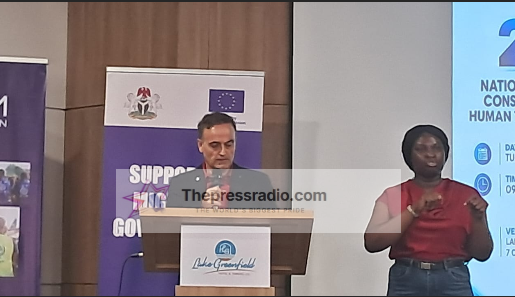
Speaking in Abuja on Tuesday at the 29th National Stakeholders Consultative Forum on Human Trafficking in Nigeria, FIAP Deputy Team Lead Javier Leon emphasized that the ongoing review of the country’s National Action Plan presents a critical opportunity to assess gains, address gaps, and set clear priorities for the next phase of interventions.
Leon noted that while Nigeria has made notable strides, human trafficking persists depriving victims of their freedom, devastating families, and costing migrants their lives. Through a European Union-funded initiative, FIAP collaborates with the National Agency for the Prohibition of Trafficking in Persons (NAPTIP), the United Nations Office on Drugs and Crime (UNODC), and local partners to bolster institutional and investigative capacities. However, Leon stressed that lasting impact requires deep trust and coordination across government agencies, civil society, and international partners, ensuring survivors receive protection, justice, and genuine opportunities to rebuild their lives.
NAPTIP Director-General Binta Lami Adamu Bello echoed the call for unified action, warning that human trafficking continues to disproportionately affect women. She highlighted operational gaps caused by the absence of NAPTIP commands in key transit states specifically pointing to Delta State, a major trafficking corridor and noted that while 25 states have established anti-trafficking task forces, 10 states are yet to do so ahead of the review of Nigeria’s 2027 National Action Plan on Trafficking in Persons.
Attorney-General of the Federation and Minister of Justice Lateef Fagbemi reaffirmed the federal government’s commitment to tackling the root causes of trafficking, linking the crime directly to poverty and socio-economic vulnerability. While citing poverty-reduction initiatives under President Bola Tinubu’s Renewed Hope Agenda alongside judicial and intelligence reforms, Fagbemi urged state governments to take greater financial responsibility for anti-trafficking operations rather than leaving the burden solely to Abuja.
Meanwhile, Osita Osemene, President of the Network of Civil Society Organisations Against Child Trafficking, Abuse and Labour (NACTAL), pledged to mend strained working relationships between NAPTIP state commands and NACTAL chapters.
“I have seen that in some states the relationship between NAPTIP command and NACTAL are strained. We shall change this,” Osemene said, urging NAPTIP to encourage partner NGOs to register under NACTAL to streamline national reporting and coordination. Despite operational hurdles, he noted that regional comparisons with counterparts in Ghana, Mali, and Senegal show Nigeria leading in government-civil society collaboration.
Goodwill messages reinforcing international backing were also delivered by the European Union, UNODC, the International Organization for Migration (IOM), the Swiss Embassy, and the International Centre for Migration Policy Development (ICMPD).
Source: Thepressradio.com